Tuesday, November 8, 2011

How-To DIY: Natural/Passive Heating & Cooling.


How-To DIY: Natural/Passive Heating & Cooling.

The following how to overview on natural/passive heating and cooling is taken right from a guide I wrote on the subject available at www.agua-luna.com.

Either you’ve just spent the last months constantly attempting to keep your home warm during the fridged winter months or you’ve battled endlessly trying to keep your home cool in this smoldering unending summer heat.

Or maybe still you’ve spent the last months be it summer or winter nice and comfortable, yet you’re dreading the end of the month when that $2,000.00 utility bill arrives. Either way one or the other is just around the bend and it’s now, once again, time to make the proper preparations to your new or existing home.

Why not stop the loosing battle now! Don’t repeat the endless mistakes of so many millions of Americans by simply adding more fuel to the furnace or burning more energy in that AC this year. Incorporate some form of FREE Natural or Passive Heating and Cooling in your home today!

Natural heating and cooling systems utilize Free passive and Natural methods in order to save YOU money and the planet heartache. In fact, it doesn’t really matter whether you are getting ready for winter or summer, since most of the natural heating and cooling systems I will be showing you how to build in the following chapters, not only protect your home from the upcoming heat, but the same methods will protect your home from the cold weather as well.

We all know that Air conditioners are probably the best method for keeping a home cool. However we ALL also know that the quality and massive cooling properties of air-conditioning, doesn’t come without its downfalls… COST.

Air-conditioning units, especially central air-conditioners are VERY expensive to buy and install, and even cost more to maintain and run. Actually, most homes in the US don’t even have air-conditioning for this very reason and only a small percentage have central air-conditioning which come with a very large price tag indeed. It costs upwards above $20,000 to install central ACs in homes without existing central air conditioning installed.

Alternatively, folks that can’t afford such extravagant systems opt for window based models which are far cheaper, but lack greatly in their ability to cool large areas and require a much larger supply of electricity, resulting in skyrocketing monthly utility costs. Basically, what’s saved in the purchase and installation costs goes right out the window (literally) in utility bills.

Minisplit air-conditioning systems are a combination of central and window based technologies making a system more economic on the pocket book, while bringing the cooling power of a central system to the masses, however these products aren’t available widespread in the US as of yet.

Conversely, most homes do have heating systems, which is a problem within itself. Every year as coal, diesel, oil and wood are burned in home furnaces, millions of tons of Carbon Dioxide CO2 (which does not burn and is in fact a large percentage by weight of the fuel burnt) enters the earth’s atmosphere not only destroying the ozone layer but creating a greenhouse effect as well. This waste of resources is contributing to global climate change and you’re not only letting it, your paying for it as well. You’re actually paying for the majority of your heat (just like your cooling) to go right out the chimney, again literally.

FACT: The current heating and cooling systems in your home, uses far more energy than any other appliance in the building.

Air conditioners can use up to 1/6th of the electricity generated in the U.S. daily. On the hotter summer days, ACs actually consume over 43% of the United States peak power load and are frequently the cause of super grey or blackouts, often leaving not only entire cities but sometimes entire states or multiple states in the dark with not only no power but no type of cooling what’s so every.

Exactly like what occurred in 2003 in the north east United States. Refer to the below link and Image.

http://www.cbsnews.com/stories/2003/08/15/national/main568422.shtml

Over 50 million people were left without electricity, and worse, without cooling systems of any kind when a single power plant experienced excessive draws due to air-conditioning overuse, triggering an overload shutdown process in itself starting a domino effect; which caused the shutdown of 265 additional power plants, 22 of which were nuclear. This in turn caused blackouts from New York, New Jersey, Baltimore, Connecticut, Massachusetts, Michigan, Ohio up into Canada. Street lights, all phone services including cell phones, TV, radio stations, internet, trolley’s, trains, airports, business, of course electricity, even water couldn’t be pumped to homes; all failed because of the blackout.

Funny outcome to this story though; for the first time since the East had become a major metropolitan area way back in the early 1900’s, residents were “surprised to see thousands of strange bright lights in the sky” (stars). Folks that had never left the city their entire life could, for the first time, see stars, only possible through the lack of light pollution in the region as well as air pollution and smog because the factories and power plants were offline as well.

According to the US Department of Energy, heating and cooling systems emit over a half billion tons of carbon dioxide into the atmosphere each year, contributing greatly to what we call for the lack of a better term, Global Warming or now referred to as Climate Change. They also generate about 24% of the nations' sulfur dioxide, a chief ingredient in acid rain. So it’s no wonder that having an entire region of one of the most densely populated and industrial countries in the world, shut down and offline for a week would clear up the night sky enough to give its inhabitants views of the celestial body’s.

We may laugh at the thought of people having never seen stars before in their life, but the story doesn’t have a great ending…

The blackout occurred on August 14th 2003 and lasted 5 days until August 19th when the last affected areas were back on the grid. Unfortunately because the temperature those days were over 95°F, and because the buildings were never built with natural heating or cooling in mind, in fact many buildings had windows that were designed to not open at all in the first place. This caused heat to build up quickly inside of these structures, turning bedrooms into instant furnaces, literally cooking many to death in their beds. Deaths were not only caused by cooling issues, several reports found deaths caused by fire due to the use of candles for lighting, heart attaches from having to climb several flights of stairs to reach apartments when elevators became non operational and food poisoning from rotten unrefrigerated meat. All of which could have been avoided with a few simple and cheap natural cooling fundamentals, added during the initial construction.

Natural cooling doesn’t need to cost a fortune, it doesn’t require any expensive retrofits or professionally installed systems what’s so ever, in fact, in most instances the consumer can implement natural heating and cooling modifications to their own home and cool or heat their home for free or very inexpensively, while causing less or no impact to the environment as well as their pocket books themselves.

You’re probably wondering now, ‘What exactly is natural heating and cooling anyway?

Natural or Passive heating and cooling methods employ the sun to work both as a heating agent warming your home during the cold months, eliminating the need for extra or traditional indoor heating; and a cooling agent during the warmer months, cooling the home drastically, when the sun is at it’s hottest.

Surprised? Sounds like a contradiction in physics right? Wrong, in fact physics, more specifically, thermal dynamics, is exactly what allows the sun to actually cool your home so much, that the need for additional cooling or air-conditioning isn’t needed at all. But we’ll talk more about that later.

Most folks think that the term ‘passive’ means or relates to solar power. Although some passive heating and cooling systems do and can incorporate direct solar interaction or gain, it’s not necessary to carry out passive or natural cooling and heating with direct sun light. Rather natural cooling and heating focuses more on how the building is designed, the direction it’s facing, its location, the material it’s made with, and the incorporation of indoor and outdoor heating or cooling blocking or reflecting medias and techniques.

Check out the next part of the guide next week.

And don't forget to pick up a copy Dan Martin's newest book: Apocalypse, How to Survive a Global Crisis, available in bookstores now.

Thursday, March 31, 2011

Flexible Fuel Vehicles and DIY Ethanol. How to run your car with alternative fuel.

Flexible Fuel Vehicles

Children, during their younger elementary days, have been taught in school that cars pollute the air and cause damage to the environment. However, as they get older, this information seems to slip their minds and some even get into the hobby of cars.

However, although in general, that information is true, there are actually some cars that do not cause a lot of damage to the environment. One of these is the FFV or Flexible Fuel Vehicles, also known as dual-fuel vehicle and flex-fuel vehicle. A flex fuel vehicle is environment friendly and it doesn’t cause much hassle on your part.

Are Flex Fuel Vehicles Expensive?

If you’re thinking that you will be shelling out more money to convert your car into one, think again. Many cars out there today – yes, most likely even the one you’re driving – is equipped to run on fuel other than just gasoline. That means that your car may be ready to run as a flex fuel vehicle and you don’t have to go on spending a lot on gasoline and polluting the environment at the same time.

Since the car you are driving is readily equipped to be a fuel flex vehicle, all you have to do is learn how to create ethanol alcohol to enjoy cheaper and cleaner fuel, which by the way may even extend the life of your vehicle – which in the long run saves you money!

How Do Flex Fuel Vehicles Work?

Flex fuel vehicles should not be confused with bi-fuel vehicles. Bi-fuel vehicles run on two kinds of fuel, each stored in a different tank and each used one at a time. Flex fuel vehicles, on the other hand, only has one tank where the fuel mixture is stored. The blend is being burned or used up by the engine as fuel injection and spark timing are automatically adjusted by engines with flex fuel capabilities.

Flex fuel vehicles run on a fuel blend of gasoline and ethanol. The most popular one is the E85 flex fuel vehicles, which means 15% gasoline and 85% ethanol. Although in some countries during winter, the proportion is adjusted to E70 (in America) and E75 (in Sweden). However, a variation in flex fuel vehicles include the Brazilian flex fuel vehicles which can run from E20 up to E100 (100% hydrous ethanol alcohol) – and is just equipped with a small built-in gasoline reserve tank for starting purposes during days when temperature is below 15 oC.

Why Ethanol?

Ethanol is not a fossil fuel which means it is much cleaner than the usual petrol gasoline. Ethanol is a renewable fuel made from plants and is biodegradable; which means no harmful effects on the environment, plus it doesn’t increase greenhouse effect. It also has a high oxygen content which lowers carbon monoxide levels by 25-30%. And the best thing is: ethanol blends can be used in all petrol (gasoline) engines without modifying it.


DIY Ethanol

Making your own Ethanol is not that hard and can save you hundreds of dollars if done correctly. The price of your fuel can be as little as $1.00 per Gallon.

If you’re fed up with the price hike in gasoline these lasts months, Agua-Luna DIY Ethanol guide is for you. If you have ever made your own beer or wine, the process will then be very familiar, but if you haven’t made beer or wine, don’t worry about it, we will guide you step by step, is very easy!!!!. The real good news is that you may not have to do any mechanical work or changes to your car or truck. It may already be factory ready for E85.

Create a healthier tomorrow for your children and start saving hundreds, start the flex fuel habit today.

Tuesday, March 22, 2011

Agua Luna - Build Your Own Solar Cell: Should You or Should You Not?

The sun seems to be the ultimate resource of the planet. Agua Luna Solar Cell provides light for daytime, it is needed by plants for it to grow and bear fruits, animals and other mammals’ bodies generate vitamins and minerals that need the sun to activate it.

However, because of climate change and the thinning of the ozone layer, most people have begun associating the sun with negativity such as skin cancer, heat stroke, sun burns, and the like. But what people have missed out is that the sun has one more gift to mankind: unlimited (and free) energy.

Find how to Build your own solar cell at http://www.agua-luna.com on our product section.

How Does the “Agua Luna” Sun Power Things?

Basically, the sun’s energy is capable of powering a really big area, but it needs an instrument for this energy to be converted into electricity. This is where the Agua Luna solar cell comes in.

The solar cell, also known as a photovoltaic cell functions mainly as a device that absorbs sunlight and converts it into electricity – but it doesn’t get converted just like that, there’s a process involved.

The photons (from the sun’s light) are absorbed into the Agua Luna solar cell by a semiconductor material. The electrons are then released from its host atom which then allows them to move freely as electricity. Since a single solar cell can only generate a minimum amount of power, a number of cells are put in a series – just like batteries, so that the power generated becomes bigger. The electricity from this cells passes through a larger array where it becomes DC (direct current) energy – the same kind of energy you get from batteries. However, since appliances and other things in a household need AC (alternating current) energy, it is converted into this through a device called a converter.

Are “Agua Luna” Solar Cells Practical?

The answer is: of course, it is. The solar cell is actually made of silicon – an environment friendly material and totally non-toxic; although today, there are experiments as to other substances that may be used for this kind of concept which might be cheaper and much more practical for the budget of the average Joe.

Plus, because of the social awareness of Agua Luna saving the environment, there are some countries or areas that actually give incentives to people who “go green”. People who make efforts to take action for the earth’s preservation are actually given consolation. So for those who have solar cells, if the weather is extremely sunny and hot, you are most likely to have excess energy by nightfall and this excess energy can be sold back to the grid. And it is usually bought from you for a higher price as an incentive for your efforts to “go green”.

So not only do you save the environment, but you also save money as well. So if you’re asking if it’s practical, then it definitely is.

Find how to Build your own solar cell at http://www.agua-luna.com on our product section.

Wednesday, April 7, 2010

Save Hundres on Utilities by using the Sun: Solar Water Heater is a Must. Learn How to DIY!!!

All throughout the world, almost 70% of the total energy in residential and industrial communities is used for heating. And since alternative source of energy is constantly being advocated, solar energy has been found useful for water heating by using the principles of natural conductive heat transfer.

Natural conductive heat transfer happens when heat is transferred by the fluids, as it maintains a circulating motion, due to its buoyancy from the change in density induced by heating itself. And in order for this to be applicable for the convention of families and individuals, solar water heaters were developed to suit the needs of every household.

Solar water heater is an economic and environmental system to produce hot water for your convenience. They are very ideal in almost all kinds of climate, and you no longer have to bother refueling it.

Basically, solar water heaters have two types, the active system and the passive system. The active solar water heater mainly depends on the external power that generally run the pumps in order to allow the flow of heat that had been gathered. While passive solar water heaters are much dependable and would costs less per unit of heat it stores. The simplest form of this is the Integral passive solar water heater which is also called as batch heaters. They are very cost – effective due to its ability to become independent from external power which leads to longer use.

The majority of solar water heaters involve a well-insulated storage tank. They (solar storage tanks) have supplementary outlet and inlet connected to the energy collector.

There are three varieties of solar collectors for residential use to choose from that would specifically suit your needs and tastes:


a. Flat-plate collector is an insulated, weatherproofed box which contains a dark plate absorber beneath one or more glass or plastic polymer covers.

b. Integral collector storage system, also known as ICS or batch systems is an insulated, glazed box which features one or more black tanks or tubes.

c. Evacuated-tube solar collector contains rows of parallel transparent glass tubes.

Remember that in choosing the solar heating system to be used in our household, we should always consider the economics and effectiveness of the solar water heater model and system in order that we put more value into every dollar that we invest into it.

You do not have to spend hundreds or even thousands of dollars on a solar water heater like the ones on market today,

you can build your own Solar Water Heater good enough for all your home needs or at least lower your gas or electricity consumption using a hybrid system solar-regular water heater.

Check out Agua-Luna.com product pages where you will find the How to Build a Solar Water Heater book containing 3 sets of plans simplifying construction and installation saving you hundreds. Perfect for pools, hot tubes, residential and industrial needs.

Wednesday, March 24, 2010

New Book “How to build a Compost Toilet”

When it comes to your needs, everything is provided for by nature. So giving something back to Mother Nature is just what you should be doing. But then, what could Mother Nature need from you? Simple; just take care of the environment, and you will be taken cared of too.

Nowadays, many environment preservation plans have been put into action, including waste management. The Compost toilet perfectly answers this call.

Also known as “waterless toilets”, “dry toilets” and “biological toilets”, the composting toilet is actually a toilet with the main goal of breaking down human waste into humus, a substance that resembles soil, rather than flushing it down the sewer system where vast amounts of chemicals and water are used to do what nature does naturally.

Today, compost toilets are popularly used in RV’s (Recreation Vehicles), boats, cabins, hunting lodges and even suburban homes. While some go for the commercially manufactured ones, others prefer to make their own which is less expensive and in mo

st cases, more functional than the store-bought ones.

Agua-Luna.com NOW brings you the secrets on how to build your own affordable Compost Toilet . Find it in our Product section!!!

Tuesday, March 16, 2010

Unique 160ac 100% self sufficient homestead up for auction on eBay

Agua-Luna has a very unique auction on eBay of an interesting Eco home/homestead, that was built to allow the owners to sustain the “fall of civilization in 2012” or at the very least live without bills.

It has its own hydroponic gardens and manages livestock for food, rain water harvesting and purification system for water and, solar panels and wind turbines for electricity. Because of this it is entirely off the power grids and the owner doesn’t pay any utility bills. On top of this it’s built entirely out of recyclable and reclaimed materials.

I’m posting here to show people about this place, put it out there and get more people thinking Eco orientated and on renewable energy. Because you always hear on the news that this sort of thing is impossible or impractical, yet here it is.

Their place can be seen on their website http://www.agua-luna.com or the eBay auction is:

http://cgi.ebay.com/ws/eBayISAPI.dll?ViewItem&item=170455571520


Wednesday, March 10, 2010

How to make a solar panel power electricity system for less than $150 dlls. Solar Home design research.


Agua Luna brings to you a NEW BOOK.

The wonderful world of Photovoltaic’s, otherwise known as solar power, doesn’t have to be restricted to the rich. You can build a simple solar panel power set-up that can run all the lights in your home, a TV, stereo, computer, or similar electrical device. All you need is 1 solar panel, 1 battery, 110 volt inverter and a set of car jumper cables. All the parts for no more than 150 dlls.

You can now run electricity your laptop, Blackberry, Ipod, Iphone or any other electronic, wherever you are. You can even run any 12v appliances. Take them camping, to the beach or as a solar home design and you’ll never be far from a plug again.

This is a simple solar battery power system to run some basic electronics that anyone can put together. However if you’re looking for a more complex system, or to learn how to make your own solar cells and panels, check out Agua-Luna’s Free Energy DIY plans to build Solar Cells.

http://www.agua-luna.com

Friday, February 26, 2010

New Agua-Luna.com website : FREE Solar, Wind and Water Energy; live off grid, alternative energy plans and information on hydrogen gas to run your car

Agua-Luna.com has a brand new look! The new website has the same great expertise in energy efficient projects but with some new added features. We are offering consultation services to both individuals and businesses worldwide. We are dedicated to helping people live as we do. Our consultation services will help you look at all the aspects of building a home off-grid, while helping you obtain the best end product to fit all your needs. If you would like to host Agua Luna for a workshop, please contact us via our website for more details.

We have added some great products to our website. Check out the how-to books and the plans in the product section. We have books for those interested in building green projects and books to help you become more energy efficient at home. All of the books and plans sold on Agua Luna have been written or/and compiled by us and tested several times.

“Help us to Help” is Agua Luna’s Green Fund motto. This fund helps Agua Luna with projects such as the Amazon Project or the Recycle Project. For every dollar you use to purchase our books, t-shirts or other re-usable items at the new website, we will place a dollar into The Green Fund. This fund allows us to help people become more energy efficient, and allows us to bring green technology to places in need of more reliable energy resources.

One of our newest projects is to rebuild homes from recycled materials. Some of these homes use renewable energy making them energy efficient. Some are made to be completely off grid. The sale of these homes allows us to repeat the process and help make more of these homes available.

While visiting the new and improved Agua Luna website, stop by and check out our photo gallery. There you will find a slide-show detailing the work we have completed all over the world. You will find pictures of our Peru project, how-to projects, homes we have made available for sale and even one of our current off the grid homestead.

Take the time to visit our new website Agua-Luna.com and leave us a comment about how you like the new look!

Tuesday, December 8, 2009

Green Gift Guide. Live off the grid, solar panel energy, biodiesel, biofuels.

We know that not everybody can live a self sustainable life, but EVERYBODY can live GREENER, and Agua-Luna is always helping you to make the conversion.. even if is just your first and a small one.

Now that the holidays are here what a better gift than a green one...


Give one of our GREENGUIDES as a gift. Perfect for the DIYers


Give CARBONCREDITS as a gift. To show that you care for the planet. Spread the word.


Give LED BULBS as a gift. This will give to your love ones hundreds on saving every month!!!


MORE GIFTS

Steffany Boldrini from www.EcoBold.com does video reviews of all kinds of household green products and has made this one of a kind, top 10 eco-friendly gifts guide for the Holidays. Enjoy!

[youtube=http://www.youtube.com/watch?v=VH56KVI_fWA]

Friday, August 21, 2009

What You Should Know About Products That Are Still Being Made With Asbestos

[caption id="attachment_73" align="alignleft" width="225" caption="Green Living Step by Step"]footsteps[/caption]

You probably know that asbestos is dangerous. It can cause diseases such as mesothelioma, a deadly lung cancer, and asbestosis, a debilitating disease that interferes with breathing.

You may have heard that asbestos is banned in the United States, but it isn’t.  It is still being used in some kinds of flooring and roofing materials; in some automobile parts, such as brake pads; in some fireproof clothing; and in a number of other products. Should this be a concern?

Maybe.  It is thought the danger is small, but small is not zero. And asbestos has been banned completely in many other countries. Why isn’t it banned in the U.S.?

Here’s the scoop: In 1989, the Environmental Protection Agency drew up regulations asbestos under the Toxic Substances Control Act. However, two years later, a New Orleans circuit court of appeal overturned the regulations. As a result of the court’s decision, a ban on new uses of asbestos remained in effect, but old uses remained legal.

Asbestos is a mineral that breaks into small fibers when disturbed. The fibers are dangerous if ingested and more dangerous if breathed into the lungs. There are two primary kinds of asbestos,  called serpentine and amphibole because of the shapes of the fibers. Amphibole asbestos has been banned globally since the 1980s. It is considered the more dangerous type of asbestos because, if you breathe it, it stays in your lungs longer and causes more damage.

However, serpentine asbestos, especially a form called “chrysotile,” is still in commercial use in the United States and some other countries.

So, asbestos isn’t just something found in the attics of old houses. It might be in a product made this year. Which products should be a concern?

Auto parts, especially brakes or clutch linings. Major U.S. automakers say they do not use asbestos in their parts. However, “aftermarket” suppliers of replacement parts sometimes do use asbestos. If you buy “off brand” parts to save on auto repairs, there could be asbestos in the brake pads and shoes, clutch linings, and other “friction” car parts. Don’t assume asbestos isn’t in auto parts just because it wasn’t listed on a label.

Asbestos in brake pads or other parts shouldn’t be a danger to drivers or passengers. However, auto shop workers and home mechanics do risk danger of exposure to asbestos. The U.S. Environmental Protection Agency has guidelines for minimizing the asbestos danger of working with car parts.

Construction materials such as roof shingles, floor tiles, cement pipes and boards, caulking compounds, and joint cements. The asbestos in these products is unlikely to break away and become airborne with regular, day-to-day use. If these products someday crumble from age or disaster, however, cleanup crews should take care not to breathe the dust.

To build with natural materials check out Agua-Luna's Build your own house

Fireproof clothing and protective gear. First, if you aren’t a firefighter, stay away from fireproof clothing or fire protection gear. Especially as the clothing and gear become worn, fibers could break away and get into your lungs. If you are a firefighter, wear respirator masks with approved HEPA filters when fighting fires or training in fireproof clothing and gear.

If you do work with such products, please don’t be complacent just because you feel fine now, seek mesothelioma treatment. It can take many years for symptoms to develop after exposure to asbestos.

— Barbara O’Brien

[polldaddy poll=1791829]

Saturday, February 7, 2009

SUSTAINABLE GREEN LIVING AND ALTERNATIVE ENERGY ECO WORKSHOP . LEARN TO LIVE OFF THE GRID ON CANCUN


DO YOU KNOW HOW?


Ever dream about leaving it all behind? What happens when the power fails next time? Will you keep riding the gas roller coaster? Economy collapse, what’s next? Can you survive on your own IF need be? Do you know how?


Do you know how to…


Stop paying for Utilities?


Live with the Planet?


Break the Boundaries?


Take Control of Life?


Right Now is the Time!


This years Sustainable Living Workshop in Cancun features exciting classroom sessions, interactive tutorial lectures given by knowledgeable teachers, rewarding hands-on local projects & lab exercises, featuring at least one element of every self sufficient aspect… Natural Building, Alternative Energy, Renewable Fuels, Green Living.


Scheduled Topics may include “How to Build” lessons like…


Solar Systems

Adobe


Making Biodigesters


Recycling at Home


Compost Toilets


Rammed Earth


Ethanol


Water Catchments


Hydroponics


Earth Ships


Solar Water Heaters


Green Living


Hydrogen Generators


Hay Bale


Solar Stoves


& so much more


…workshop schedules will be distributed before arrival.


You’ll leave with enough hands-on practice & technical knowledge to implement any of the above topics in your own life. Simply lower or eradicate your bills, even retire early, or cut your connection to the grid or society completely.


FOR MORE INFO & TO RESERVE YOUR SPOT NOW CLICK HERE


ACCOMMODATIONS


The Mayan Rivera, one of the most enchanting sought after destinations in the world. Participants will stay in a real life Eco Biosphere Reserve, located on the Caribbean Coast of Mexico, near the Mayan Ruins of Tulum, south of Cancun. Harnessing Solar & Wind power, Rain Catchment & Grey Water Systems, It serves as a model for sustainable development today.


Dip your feet in the warm Caribbean waters of the white plain beach just outside your door; take a kayak trip up an ancient Mayan canal with a friendly Mayan Guide, or a snooze on a hammock on the deck of your Cabana rocked gently by the sea breeze. All while learning about Sustainable Living, Alternative Energy, Renewable Fuels & Green Living in the largest Environmental Reserve in the Yucatan Peninsula. Participants will stay in private or shared (2-3 person) Eco Cabanas, each with stunning views of the ocean / lagoon & access to clean bathrooms & showers. To preserve the natural essence of the Reserve, the Cabanas do not have electricity (candles will be available). There is an Excellent Restaurant on-site hosting fresh food at incredible rates. Classes are held in a Jungle or beach side learning center, 5hrs per day. Enjoy scheduled fieldtrips to surrounding destinations, while still having enough time to take in the sites, tours, Scuba dive, even visit the incredible nearby Mayan Ruins of Tulum. Life is yours for the taking; let us teach you how to take control of it. For more info visit or our FAQS


PACKAGE RATES


Package


Room


Rate


Queen**


private$1299

Double


dorm$1249

Single


dorm$119

**Couples Rate


FOR MORE INFORMATION ON WORKSHOP VISIT


http://www.agua-luna.com/


Wednesday, September 10, 2008

Using Solar Power. How to Recycle and save free Energy

Is time to hear what other people have to say about the environment, about what are they doing.

People have come to us and say is hard to do what Agua-Luna does, but you don't have to do it all, neither change it all in a shot, start with little steps and learn from these examples:

"I feel very strongly that we could all be doing a bit more to help the environment. The world as a whole does not have infinite resources and we must make more of an effort to make people aware of this, especially youngsters.
A family living opposite me, 2 adults with a 1 year old regularly put out 6 bin bags and never seem to use their recycling bin and this upsets me hugely. My family have 1 bag and recycle everything possible. I compost all I can, buy little and often to reduce waste, try to buy as little packaging with food, drive less and am aware of trying to cut petrol usage with sensible braking etc. I make an effort to unplug things that would otherwise go on standby, turn off lights where possible and use low energy bulbs. Our house has loft insulation and the walls have been done too. I am frugal with the water we use, there are bricks in our cisterns to cut flush water levels and we shower instead of bath. My garden lights are solar powered.

I have recently been writing to manufacturers pushing to have things packaged in bags or alternatives to glass jars and feel that much more could be done by the big boys to reduce waste too. The Corona pop lorry would come round and take back empty bottles and you were paid to return them, sensible I think, why not have a similar scheme now? Supermarkets in France have battery recycling bins and this should be encouraged here too. Surely if it was made easier for us to do things like this it would help.

I am confused by the recyclables symbols on things like yogurt pots, having been told by the man at the recycling center its the wrong plastic to go in with bottles and just hope it means they will degrade over time.


I am constantly horrified at how much rubbish is lying around our small island and wish people took more of a pride in the world in which we all live. Having said that though, on the 1/2mile walk to our local supermarket there is not one rubbish bin and so there are always heaps of cans, bottles and wrappers lying around, but there are 5 dog waste bins! As a small child growing up in South Wales people did take pride in the outside of their properties and I remember ladies washing their front steps and sweeping the pavements. Nowadays I am ashamed to say I have seem people stop at their doors and throw wrappers over their shoulders onto the ground and shutting the door!

I think education is the key and have a loud voice that I would love the opportunity to have heard, thanks so much for at least giving me this small chance to rant!"

Thanks to Belinda Lewis Bird


Unplug things instead leaving them on stand by can represent a huge save on e electricity. We recommend to have your appliances or electronics on power strips to make this task easy.

You can also check out the new intelligent power strips that are being develop to save energy like checktap

Monday, September 8, 2008

Living Environmental Friendly. Start Homesteading with organic food, recycling and avoiding the toll on Gas prices

Is time to hear what other people have to say about the environment, about what are they doing.

People have come to us and say is hard to do what Agua-Luna does, but you don't have to do it all, neither change it all in a shot, start with little steps and learn from these examples:

"Hi, my name is Iris, and this is what me and my family are doing for the environment. First we live near our jobs therefore using the car less and less. We are using canvas bags to bring our groceries home. We are switching over to florescent light bulbs. Next I have taken T- shirts that no longer fit our children and are in great condition and have turn them into some cool pillow case, they are soft and a conversation piece. I have decided to turn a laundry canvas hampers into recycle bins. We are new at all this ,and we live in an apartment so this is a great challenge for us. Yet we are striving to make a difference. We try to only purchase organic fruits and veggies. We buy real butter instead of margarine, and are looking into which grocer sells meat that has no hormones or coloring of any sort. We would start a small box garden but our deck does not get sufficient sunlight. Like I said we are new at all this, and have only just started. Thanks for all your articles."

Thanks to

Friday, August 15, 2008

SAY NO TO PLASTIC BAGS. USE REUSABLE BAGS!!! USE FREE ENERGY!!!

USE REUSABLE BAGS!
[youtube=http://www.youtube.com/watch?v=_F8IQRw-1Hw]
One single plastic bag releases 6.25kg (13 lb) of carbon to the environment when is produce.

SAY NO TO PLASTIC BAGS

For an Eco-friendly Agua-Luna.Com canvas bag go to:

http://www.cafepress.com/agua_luna_com.282055648

Join the Change!!!

Every purchase donates $5 to the Agua-Luna reforestation project.

Donate to the Green Fund

http://www.agua-luna.com

Monday, June 2, 2008

Agua-Luna.com Help out in The Amazon

AGUA-LUNA.COM WAS ASKED TO COME DOWN TO THE AMAZON AND ASSIST IN SEVERAL RENEWABLE ENERGY / SELF SUSTAINABLE PROJECTS ON THE AMAZON RIVER, IN THE RAIN FOREST AND IN DEEP JUNGLE. HERE ARE A FEW PICS OF THE TRIP AS WELL AS SOME COMMENTS ON WHAT THEY WERE ABLE TO ACCOMPLISH IN SOUTH AMERICA. FOR MORE INFO OR PICS FEEL FREE TO VISIT WWW.AGUA-LUNA.COM


Virgina from Espiritu de Anaconda (a Shamanistic retreat in The Amazon Jungle), Julian from The Pyramid Project (a gigantic floating Pyramid on The Amazon River), brought a Agua-Luna.Com team to Peru to help out, design several Renewable Energy / Sustainable systems for several sites. After a 2 week trip into the jungle, the sites were evaluated, gathered enough info to now return, draw up some blueprints. Agua-Luna team is eager to help, but it was determined (later proven) that an on site consultation was necessary. It was definitely worth the trip. Thanks to everyone that helped out , all the volunteer's that contributed. Enjoy the pics....


AGUA-LUNA ARRIVES IN THE RAINFOREST


After 3 days of travel Martin and Lucy arrive in Iquitos, Peru and hire a mototaxi to The Pyramid Peru Project.


MOTO TAXIS


For a couple Soles one can travel pretty much everywhere in Iquitos and there inlays the problem. Iquitos has over 30,000 of these mototaxi's (converted motorcycles) making it the noisiest city in the world. Agua-Luna will be teaming up with Pyramid Peru to convert them to battery power (Agua-Luna has made many bigger conversions already, this would literally be no problem).


MARTIN PUSHES MOTO TAXI


Most roads are dirt and as it rains every day in the rain forest they're always muddy.


MARTIN AND LUCY AND THE MOTOT TAXI DRIVER


Having lost a solar panel and the luggage on the way, Martin and Lucy were happy to have made it at all.


PYRAMID PERU


Martin wanted to make a quick stop at The Pyramid, meet Julian Haynes, the man behind the dream


MARTIN AND JULIAN TALK HYDROGEN


Within minutes Martin had a hydrogen generator built using a plastic water bottle and was showing how to make Hydrogen from water (in this case water from The Amazon River).


JULIAN PEERING OUT OVER THE AMAZON RIVER


The team was impressed with Julian, a native Brit who now resides in Peru. His dream is to build an enormous floating pyramid on the Amazon River as a place for all Shamans to come together.


JULIAN AND MARTIN TALK RE ENERGY


Half of the reason Agua-Luna came to Peru was to build a Renewable Energy system for Julian's Pyramid Project.


MARTIN AND LUCY AT LOCAL EATERY


After an exhausting few days of traveling the team catch a quick bite at a lovely Italian pizzeria "Antica Pizzeria"


Martin with an Anaconda Tribal Dancer


After dinner on the way back to the Pyramid they got stuck in a local festival.


Anaconda Tribal Dancer, Anaconda and Lucy


Lucy was not sure why she got the Anaconda around her neck.


Martin & Sebas


Sebas was our local tour guide for the night.


Lucy and a shot of Pisco


Lucy's not one for drinking, but she was told that she have to try "Pisco". It tasted a lot like Tequila to her.


Downtown Iquitos at night


Heading back to the Pyramid along the boardwalk.


Martin in The Amazon


After a long day of drinking and designing (not in that order), Martin takes a night swim in The Amazon River.


Martin & Julian talk water bottles


Martin explains some of natures finer points on such things as buoyancy, compression and decomposition. In the end he suggested 55gal industrial plastic drums filled with air or nitrogen to float the Pyramid.


Julian & Martin


One of the greatest journeys undertaken in a long time, seems to have been put into motion in order to get these to into the same room together.


Martin talking batteries


At the biggest battery shop in Iquitos, Martin asks about deep cycle batteries, which no one in Peru seems to have a clue about. "ya, ya it's deep cycle" is what you'll here about EVERY regular car battery. Then 1 month later you'll be stuck with a dead solar system and when you go back to ask about the batteries they'll say "that one was faulty". Same problems were experienced finding chargers (which were labeled "40amps" but turned out to be "17amps" when Martin tested it. It seems this is normal in Peru possible all of South America at no fault of the shop owners. The fact is distributors ship down rejects material & items to these countries.


Martin evaluaiting the \'web\' structure


The structure of the Pyramid relies on structural properties of different shapes for strength, stability and longevity (triangles, heptagons and ,of course, the Pyramid). Martin and Lucy are eager to see the finished result.


Martin goes to Julian for shopping advice


Another quick stop at the Pyramid to touch base with Julian, explain the days activities running aimlessly around town searching for parts.


Martin & Julian talk batteries, highlighters & more


Martin explains the battery situation to Julian, that a solar system needs deep cycle batteries that are designed for constant 100% cycles, not normal car batteries which are designed to be always topped off. 2 days later Julian was teaching others the difference. Hopefully Agua-Luna can import some Optima's from Brazil in the near future.


Julian & Martin talk... well everything


What starts as a quick stop, turns into a half a days conversation. Lucy learned (stand corrected) that it's important to NEVER let these 2 alone in the same room together. It very well mean the end of the world as we know it. Literally.


Julian & Martin talk


To tell the truth nobody is sure at this point what they were discussing. Neither sure if somebody wants to know. From the looks of the notations on the paper and the figures on the calculator though it seems that they may be trying to figure out exactly how much food they would need to have ready to sustain the population of earth by 2012.


Another MotoTaxi ride to our second destination...


With the rain pouring now it seems impossible for the driver to see let alone make it to the second project site.


Local kids push the MotoTaxi


Local kids push your MotoTaxi for a Sol through the muddy street of The jungle.


Downhill


On the downhill parts they get a break and jump on back for the ride.


Espiritu de Anaconda


Agua-Luna team finally make it to Espiritu de Anaconda. Martin and Lucy are VERY eager to meet Virgina and the rest of the group responsible for bringing them to this beautiful country.


Julio (the guide) & Lucy


Julio, a remarkable young man was the personal guide for the some 2 weeks in the jungle. Martin have worked with a lot of locals in many countries and have never seen such raw potential and devoted Heart in a person. Ever. There's absolutely no way the work could have get done without him. Thanks Julio.


Martin & a real life Amazon Princess


Martin gives a small puzzle to Gabriela the daughter of Soi Yaca, also known as Sonia, wife of Kestembetsa, also known Don Guillermo the village Shaman and leader. (photos of Don Guillermo were not taken out of the highest religious respect.)


Martin & a real life Amazon Princess


Gabriela inspects her gift for any flaws of perfection (princesses are very thorough).


Gabriela & her puzzle


Gabriela runs right into the house to play with her new puzzle.


Sonia & Lucy talk shopping


Lucy tell Soi Yaca, also known as Sonia that a local was needed to gather the parts to build the solar system as a lot of valuable days were waisted trying with no success by Martin & Lucy. She elects to do it herself after hearing about the difficulties.


Julio & Martin evaluates every hut in the village


Agua-Luna was brought to Peru to evaluate and design 3 sites... The pyramid, Espiritu de Anaconda and the new Shaman site deep in the Amazon Jungle. Julio was with with the team every step of the way.


Julio & Martin on 1 of 30+ village huts


Martin documents necessary info on each hut for use later when blueprinting, in order to bring solar electricity to each.


Francois house


Francois asked Agua-Luna team if they could design a small RE system for his house while they were on site.


Francois 60ft water tower


Francois, a French entrepreneur now Apprentice Shaman to Don Guillermo. Martin would like to install a solar hot water heater on the very top, as well as a few solar panels.


Another hut inspection


Amazingly almost every hut is different and requires a different setup.


Yet another hut


Lucy dream of huts this night.


Fish hut


This hut is rather unique as it is the main food supply for the village. The rather large family raises thousands of river base, chickens and some rather odd birds that Agua-Luna team can honestly say they've never seen before.


Odd bird & Lucy


This bird reminds Lucy her turkeys back home, but may be closer to a peacock. It makes the most alarming sound you'd ever heard.


Jungle bridge


As most of the jungle is either damp, flooded or is a river, bridges need to be built to get to most places.


Martin & the bridge workers


Martin stops for a quick chat with the bridge workers. During the 10+ days we were in the area they had built almost the entire bridge. About 300 meters worth.


Virgina\'s home


Virgina, a native Austrian now living most of the year in Iquitos, is the reason behind Agua-Luna team coming to Peru and being able to help so many. As a result of her tremendous generosity, not just towards Agua-Luna, but all of the Espiritu de Anaconda community, Martin has agreed to absorb fees or costs involved with designing her home as well as the other 3 projects completely free of charge. It's just Agua-Luna way of helping out when so many have already done so much. (no photos were taken of Virgina upon request for her privacy).


View 2 of Virgina\'s house


The home is actually 2 buildings and will have a water tower much like Francois in the middle, to harness the system with rope bridges connecting, suggested by Martin.


Virgina\'s house view from 3rd floor


The Peruvian workers are fearless as they travel like monkeys through the rafters without safety equipment.


Martin at Virginia\'s house to floor


Martin sketches a quick pre design of Virginia's home.


The Maloca (ceremony lodge)


Martin and Lucy were thoughtfully invited to several Shamanistic ceremonies while we stayed in the village. A very enlightening experience to say the least.


The Maloca beds


The Maloca from inside.


Water Turbine


Martin guides the construction of a water turbine that will be used to power a near by hut.


Water Turbine front view


Martin explains about Rise and blade surface volume needs and the difference between alternators and generators (Permanent magnet alternators).


Martin & the Water Turbine builder Gilberto Fernandez.


Martin with the Turbine's builder Gilberto Fernandez, Agua-Luna looks forward to working with him in the near future.


Julian & Martin at the Pyramid


Yet another stop at the Pyramid in order to weld up a frame for the new solar panels. Julian gets a couple of his welders for the job.


Martin & the 2 welders


The welders prepare the steel.


The 2 welders in action


The welders make quick work of the frame, Agua-Luna team were in and out of there in a couple hours.


Lucy in the Pyramid


While the boys play with their metal Lucy gets a quick tour of the Pyramid. New uniforms and hard hats now aid the workers in a safer environment.


Lucy on the deck of the Pyramid


The triangle trusses behind Lucy will later be filled with either recycled water bottles of recycled 55gal plastic drums and sunk under water. The water line will be at the hight of the top beam appx. in a few months we hope. So if Lucy were to stay here for example, I'd be under water by that time.


Workers on float


The workers bring in more wood, poles and material daily all harvested locally to eliminate carbons caused from delivery.


Martin & the Espiritu de Anaconda\'s wokers


Martin explains some finer points in the construction of Virginia's home in order for them to successfully be able to install such things as compost toilets, Super efficient lighting, rain water catchment and a lot more later.


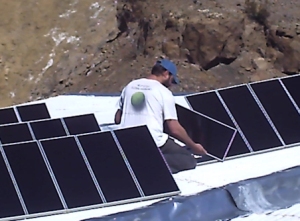
Solar installation finally takes place


Now that Sonia was able to round up all the items needed for an installation, Martin Julio and helper.


Martin checks fit of our new frame


Before final installation it's important to check EVERYTHING for fit, no one wants to be on a rough when something doesn't line up.


Frame adjustments


Upon fit check it was found that the locks that will hold the panels didn't line up, so because of time restraints they can't send the frame back out and are forced to modify what they have to fit.


Fabricating Cables


Can't find much deep in the Amazon jungle, so we were able to fabricate our own battery cables with a little welding cable & some ingenuity.


Final fit check


Frame lines up perfectly after modification & is ready to be installed along with the panels.


Final adjustments


Making some final adjustments to the panels literally takes a few seconds but can save hours on the roof


Travel to the site


It's a good trek to get to where the panels & solar system will be installed, directly South & above the village.


Martin, Julio & crew


Martin explains the difference between installing batteries in series & parallel in order to build a suitable battery bank.


Martin & Julio & visitor


As Martin & Julio calculate the angle & altitude of the solar array for the location a curious visitor comes to help.


El Guacamayo


Martin 'claims' he never even saw the Parrot but this pic is proof he did. Maybe he was just a little preoccupied to care.


El Guacamayo comiendo


At some point the bird decided that eating Martin drafting paper was a bit better then 'helping' as previously stated. As the bird tore pieces from the pad Martin didn't even move until it began to affect his math.


Lucy & El Guacamayo


Lucy tried to have him get on her arm, but she was a little hesitant to have a wild jungle parrot that close to her.


Martin the beast master


When Martin saw what Lucy was trying to do he simply pushed his arm under the bird and the bird jumped right on. Like they had practiced it a hundred times. Probably the bird didn't really new what he was getting himself into.


El Guacamayo vs Martin


After a few minutes of just staring the bird started squawking and flapping his wings and the showdown began......


El Guacamayo the Victor!!!


The Parrot struck the first and only blow, trying to decapitate Martin. Luckily Martin has a big hard head!


Maintenance instructions


After installation Lucy need to give the guys instructions on how to maintain and up keep the system so Agua-Luna team doesn't have to come back.


Conservation instructions


With renewable energy systems comes strict conservation habits. After installation Lucy needed to give the guys instructions on how to conserve the electricity so that they don't run out in a couple hours.


Bats in the Battery house


In the battery shed are tons of lively bats,Who knows if they liked the idea that they'll now have solar power or not.


2 weeks days come to an end


After a VERY long and hard 2 weeks Julian and his lovely girlfriend take us out for some drinks, just next door to the Pyramid at Nikoro bar.


A little laughter after a tough couple weeks


After 2 weeks on this project the team were literally physically, mentally and emotionally exhausted. Not because of the long time there (2 weeks is actually very short for be on site), but the opposite...Martina and Lucy tried to push everything into such a short time span that it exhausted them. Actually was supposed to go to Peru and design 3 systems, yet it turned out to be more systems and an actual installation as a bonus. It was well worth it but the team was tired.


The old plastic glove on the head bit


These clowns were SOOOOOO funny. Martin and Lucy literally couldn't stop laughing, people said they could hear them across the Amazon river. To funny. They're 'Rasta Clowns' from Chile.


Lucy & a Rasta clown Cebolla


Because Lucy was yelling out 'obscene' remarks to the clowns when they were on stage, they felt it was payback time. Poor her.


Lucy & a Rasta clown


They had the funniest time with them, they made everyone laugh so much and after Martin and Lucy got a chance to talk with them and take some photos.


Lucy & 2 Rasta clowns


Lucy was told that this would be the 'best' picture ever... Not funny.


Rasta Clown


He pretended to take a picture of Martin and Lucy (next photo)... pretended that it didn't work... looked into the camera and proceeded to take one of himself. VERY nice guys, The team hope see them again one day.


Lucy & Martin (Photo taken by Rasta clown)


Martin and Lucy thanks for the great time Rasta Clowns.


Looking for a water taxi to go down the Amazon river


The next morning was decided that at least wanted to take a boat ride down the Amazon River to see some of the wild life and Indians the team heard so much about. Here Lucy was looking for a water taxi in the port of Iquitos "Nanay" (was a little crazy, good thing it was day time)


Martin with a small monkey


The monkeys would literally jump our of the trees onto visitors' head, sticking there tongues in your ears. They would jump all over you and bite you (playfully) and if there were more then 1 they'd fight on you.


Lucy w/2 monkeys on her head


The monkeys are SOOOO playful, like a kitten on katnip amplified by 10. They loved pulling Lucy's hair, Probably they thought it was a vine. They were everywhere.


Martin catches a baby Aligator


Actually the guide (far left) caught it and gave it to Martin. As small as it was Martin had a hard time holding onto it.


Monkey with his horse


When the team went back to the dock to catch their water taxi a dog came up looking for treats. Then out of nowhere a small monkey ran and jumped on his back. They walked around like this the rest of the time beeing there.


Lucy & small monkey


This small monkey was a different breed then the other darker ones. They're weren't as many of these running around. He came to Lucy and asked for her hand in marriage (probably).


Lucy & a not sure what


This little guy is a type of rodent (not sure), but he plays with the monkeys.


Lucy & my Sloth Cristina


Finally Lucy get to hold a sloth. It's her second most favorite animal (next to the koala bear). They are SOOOO slow. Not sure what Cristina is doing, but as soon as she was picked him up to take the picture she put her arm behind her head (real slow) like she was a model.


Lucy with the Yaguas tribal leader blowing a dart gun


The Yaguas welcomed Agua-Luna team into their village with open hands. Soon they were showing them their ritual dances and teaching us how to hunt with blow guns. Very impressive.


Lucy hit the target!!!!!


Lucy hit the target on the first try, dead in the center. Every one cheered frantically, so probably that was rather unusual. (Lucy is not sure if she could do it a second time though)


Treats for everyone


One thing Agua-Luna like to do when we go do projects abroad is to bring a little happiness to the kids. The team typically bring a couple bags of toys, books and candy to pass out. It's very rewarding.


Lucy gets mobbed


When the rest of the tribe heard the team had treats they mobbed Lucy. Probably they don't see foreigners to often. Neither receive outside items.


Lucy & the tribe youngsters


After passed out all our treats, they had a few moments to take some pics before needing to catch their water taxi


Lucy & some of the tribe


Again when the word spread they were taking pictures, more members wanted to come and have their picture taken.


Martin gets a photo


After 2 weeks of Lucy taking all the pics Lucy made Martin take them when they were on our 'fun time'. But she allowed him one shot with the Indians.


The End


As Martin and Lucy caught a mototaxi back to the Airport, it FINALLY hit them they were leaving. The time went by so fast, and never really had time to enjoy it. Thanks to everyone for all their help, resources and support. Agua-Luna hope it helped and can further contribute to the efforts you all are making to change things. Thanks Virginia for bringing the team out and allowing it to do what they could for your cause, it's an honor. Thanks Julian for putting Martin and Lucy up on the Pyramid and hope Agua-Luna's RE systems will help keep you on your path. Thanks Julio for all your help, Agua-Luna like to bring you out to the Ranch to apprentice with Martin, you have so much potential. Thanks all.


Turkey babies


This pic doesn't belong in the Peru album, but we wanted to let everyone know that the day Martin and Lucy arrived back at the Ranch, one of the hen Turkeys had 7 turkey chicks following her around. We didn't even know she was laying. Shows you how busy we've become the last few months. What a nice welcome home present.


AGUA-LUNA.COM WAS ASKED TO COME DOWN TO THE AMAZON AND ASSIST IN SEVERAL RENEWABLE ENERGY / SELF SUSTAINABLE PROJECTS ON THE AMAZON RIVER, IN THE RAIN FOREST AND IN DEEP JUNGLE. HERE ARE A FEW PICS OF THE TRIP AS WELL AS SOME COMMENTS ON WHAT THEY WERE ABLE TO ACCOMPLISH IN SOUTH AMERICA. FOR MORE INFO OR PICS FEEL FREE TO VISIT WWW.AGUA-LUNA.COM